RCRC CEO: The Capital Is Witnessing a New Phase of Comprehensive Development Under the Crown Prince’s Leadership

His Excellency Minister of State, Member of the Council of Ministers, and CEO of the Royal Commission for Riyadh City (RCRC), Eng. Ibrahim bin Mohammed Al-Sultan, affirmed that the capital is witnessing a new phase of comprehensive development under the leadership of His Royal Highness Prince Mohammed bin Salman bin Abdulaziz Al Saud, Crown Prince, Prime Minister, and Chairman of the RCRC Board of Directors — may Allah protect him — noting the expanding role of RCRC to include urban and economic planning, guiding growth and investment, developing infrastructure and services, and overseeing the implementation of major projects.
This came at the outset of His Excellency’s remarks at the 37th Government Press Conference, organized today in Riyadh by the Ministry of Media and led by His Excellency Minister of Media Salman bin Yousef Al-Dossary.
His Excellency Eng. Al-Sultan explained that the Main and Ring Road Axes Development Program in Riyadh aims to develop approximately 700 kilometers of vital axes and more than 330 major intersections, including the construction of more than 300 bridges and 80 tunnels, in order to raise the efficiency of the road network and improve traffic flow.
He stated that progress on the project linking Taif Road with Qiddiya has reached 81%, while it has reached 45% on the Second Southern Ring Road project and 42% on the project of the two bridges parallel to the Suspension Bridge, noting that the main columns of the first bridge have been completed and bridge installation works have begun, alongside preparatory works for the second bridge and the construction of the intersection connecting to the Western Ring Road.
He pointed to the ongoing development works on Al-Thumamah Road axis, from King Khalid Road in the west to Sheikh Jaber Al-Sabah Road in the east, which include the development of 13 major intersections and the construction of 10 tunnels and 17 bridges, in addition to the development of Al-Takhassusi Road axis and the construction of a number of bridges and intersections associated with King Salman Road, enhancing connectivity between the capital’s neighborhoods.
His Excellency noted the completion of Al-Thumamah Road bridge at its intersection with Prince Mohammed bin Salman Road and its opening to traffic, explaining that the coming period will see the opening of new sections of axes, bridges, and tunnels, including Taif Road in the Laban neighborhood leading to Qiddiya, a number of bridges surrounding King Abdullah Financial District, and sections of Al-Thumamah Road axis.
On traffic management, he explained that RCRC is implementing engineering solutions at 26 critical locations in Riyadh and upgrading traffic signal technologies at 720 intersections and linking them to a unified control room, in addition to starting implementation at 80 sites to manage vehicle flow on main roads in the first phase.
His Excellency revealed that the number of users of Riyadh’s public transport network is approaching 500 million passengers since the start of operations, including more than 300 million passengers on the Riyadh Metro, while usage by male and female students at schools and universities has exceeded 20 million passengers.
The results of a survey conducted by RCRC showed that 83% of Riyadh Metro passengers use it daily, reflecting growing reliance on it in daily travel for work, study, and economic activities.
His Excellency announced that RCRC has signed contracts to purchase 94 new trains, raising the Riyadh Metro fleet from 183 to 277 trains and contributing to an increase in the network’s capacity, as the capacity of the Blue Line will rise from about 340,000 to about 533,000 passengers per day, the Red Line from 154,000 to 370,000 passengers per day, and the Yellow Line from 133,000 to more than 288,000 passengers per day.
He stated that work is underway on an extension of the Red Line from King Saud University to Diriyah, adding five new stations, including two serving the university and its Medical City, and three stations in Diriyah.
On environmental projects, His Excellency affirmed that RCRC continues to implement the Riyadh Sustainability Strategy, which comprises more than 68 initiatives in the areas of air and water quality, protection of natural areas, afforestation, and waste management.
He explained that the King Salman Park project, which spans more than 17 million square meters in the heart of the capital, is making progress in implementation works, following the completion of large parts of the first phase infrastructure, with afforestation works and the development of facilities and public spaces continuing.
Under the Green Riyadh Program, the number of trees planted has exceeded 4.5 million, and afforestation works have extended to 235 kilometers of roads and axes, in addition to the rehabilitation of five million square meters of valleys and their tributaries.
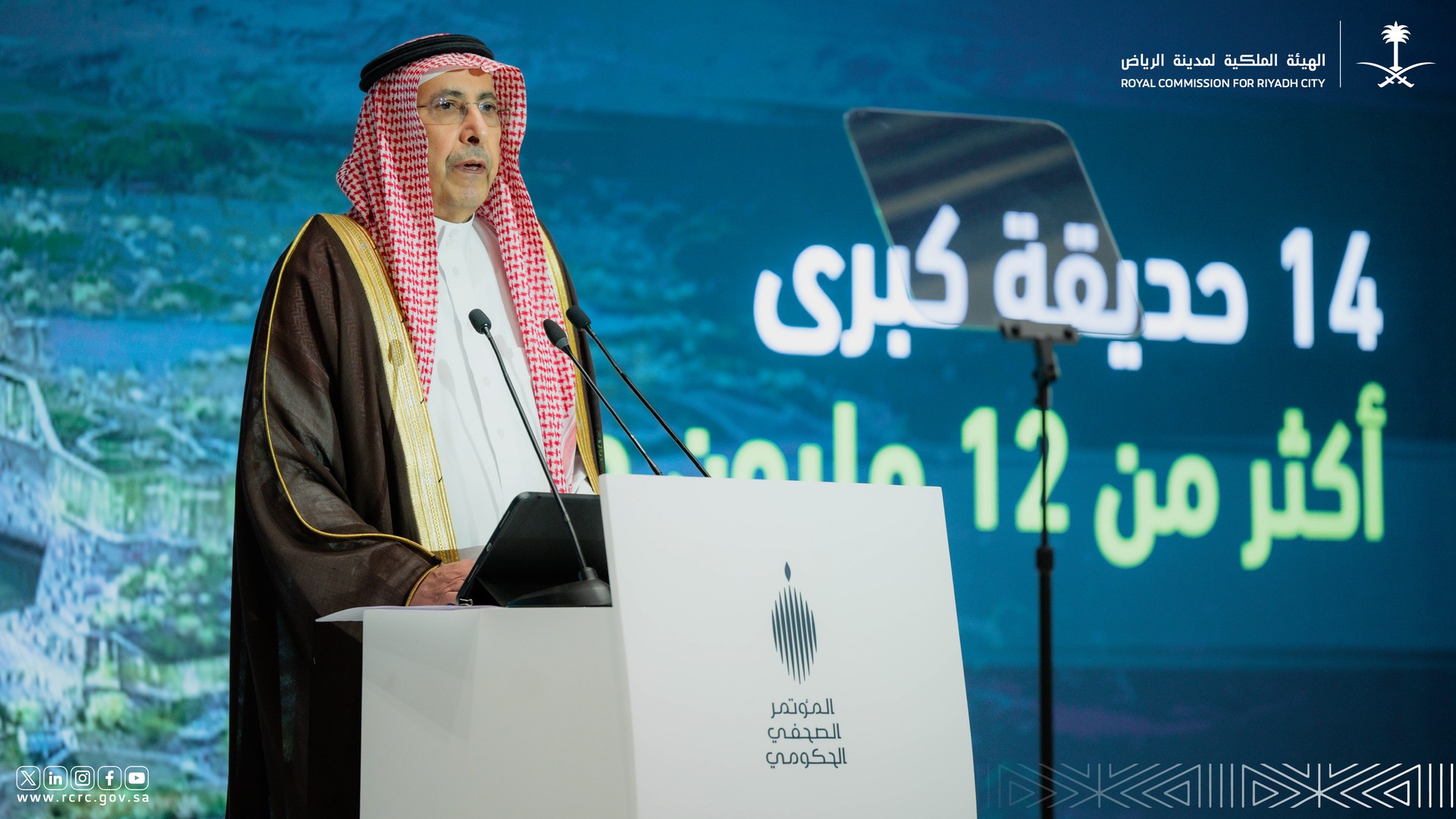
He noted the implementation of 14 major parks covering more than 12 million square meters, including King Abdulaziz Park, with a completion rate of 50%, and Al-Urubah Park at 55%, while completion rates for the major parks in eastern Riyadh, in Al-Mu’nisiyah, Al-Qadisiyah, and Al-Rimal neighborhoods, have reached 85%.
He stated that work is underway to complete more than 250 parks within residential neighborhoods, with preparations to implement more than 1,500 additional parks, in order to provide green spaces close to residents.
On the rehabilitation projects for valleys and natural areas, His Excellency stated that the rehabilitation of Shuaib Ghadhwanah, covering 700,000 square meters, has been completed, with about 40,000 native trees and shrubs planted, in addition to progress in the rehabilitation works at Shuaib Umm Al-Qasr, covering 1.3 million square meters, and the development of Dhahrat Namar Park, spanning 2.5 million square meters, to serve six main neighborhoods.
He pointed to the completion of afforestation works in Shuaib Al-Haisiyah and the valleys within the boundaries of King Abdulaziz Military College, totaling 1.7 million trees and shrubs, affirming that work continues on a specialized irrigation network that will extend more than 800 kilometers upon completion, with a conveyance capacity reaching about 1.7 million cubic meters of treated water per day.
He explained that RCRC is working to protect and develop the natural areas surrounding Riyadh, which cover approximately 10,400 square kilometers, in addition to applying measures to control dust generated by construction projects and following up on the installation of about 107 air quality monitoring stations associated with these works, as well as the presence of 17 stations monitoring air quality and climate information around the clock, and work to install 30 noise pollution monitoring stations across the city.
On the Real Estate Balance (Tawazoun) Program, His Excellency the CEO of RCRC affirmed the continued implementation of the directives of HRH the Crown Prince to take a package of measures to increase the real estate supply, provide housing options for citizens, and stimulate real estate development and investment.
He explained that the measures include providing between 10,000 and 40,000 residential plots annually to citizens over five years, at a price not exceeding SAR 1,500 per square meter.
He stated that the first year saw the allocation of more than 6.3 million square meters comprising 10,024 residential plots, noting that the handover of plots to the first batch of beneficiaries will begin in parallel with preparatory works to develop the infrastructure in five residential master plans with integrated services and facilities.
He added that RCRC has completed the phase of receiving applications and verifying eligibility for the second year and is preparing to conduct the electronic draw and allocate the plots in mid-December.
He pointed to the preparation of the preliminary master plan for the northeast area of Riyadh, covering approximately 500 square kilometers, providing future opportunities for residential and investment development within integrated planning for services, infrastructure, and the mobility network.